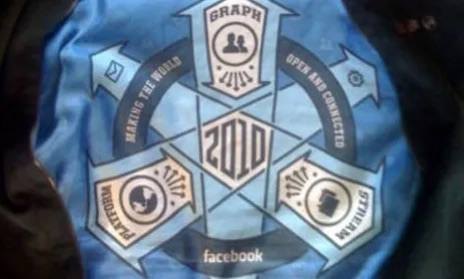
When Mark Zuckerberg appeared at a conference without his usual plain look, attention quickly shifted to an unusual symbol on his hoodie. It showed a circular design with branching arrows and a phrase about “connecting the world.” Within hours, screenshots spread online—and so did speculation.
Some viewers linked the symbol to secret societies, referencing imagery often associated with hidden networks or influence. Others saw it as something simpler but still unsettling: a visual metaphor for control over information and human interaction.
In reality, the design closely resembles internal concepts long associated with Facebook (now Meta). The platform has always been built around the idea of a “social graph”—a network of connections between people, content, and interactions. The arrows and circular structure likely represent how information flows and expands within that system.
Still, the reaction says more about public perception than the symbol itself. Today, large tech platforms are often viewed with suspicion. Concerns about data privacy, algorithmic influence, and attention control have made people more likely to interpret even neutral symbols as signs of something deeper.
There’s also a cultural layer. Figures like Niccolò Machiavelli and Friedrich Nietzsche are frequently brought up in discussions about power, influence, and ambition. While there’s no solid evidence linking Zuckerberg’s choices to these philosophies, the comparison reflects how people try to make sense of modern tech leaders using historical ideas.
In the end, the hoodie symbol was most likely a piece of internal branding—nothing more. But the speed at which theories spread highlights a key reality: in a world shaped by digital platforms, trust is fragile, and meaning is often created by the audience, not the creator.
via theweek.com